
Many Moroccan companies are starting their AI journey by creating AI teams, launching data science initiatives, and developing proof-of-concept projects. This is an important step, but it is not enough to turn AI from isolated experiments into reliable systems that run in production and create measurable value.
A proof of concept can often be built with limited infrastructure and modest compute resources. A Jupyter notebook, a local server, a small dataset, or a temporary cloud environment may be enough to test whether an idea is technically feasible. Production AI is different. It requires a complete infrastructure layer: reliable data pipelines, scalable compute, secure storage, deployment automation, model monitoring, access control, and integration with business or industrial systems.
This challenge is particularly relevant in Morocco. In its 2023 report on cloud computing, the Economic, Social and Environmental Council (CESE) estimated that outsourced IT capacity, including cloud computing and hosting in third-party data centers, represented only around 14% of Morocco’s total IT capacity in 2020. This means that most infrastructure remained internally managed, often hosted on-premise. While on-premise infrastructure can support traditional IT systems and some AI experimentation, it often lacks the elasticity, automation, managed services, and scalable compute needed to move AI models into production.
For AI adoption, this matters. Without cloud-ready infrastructure, AI teams can produce promising demos, but they may struggle to turn them into systems that run continuously, scale across the organization, and support real business or operational decisions. For Morocco to move beyond AI pilots, companies need to think less about isolated POCs and more about the infrastructure foundation required to make AI production-ready.
What Changes in Production AI
The gap between a POC and production AI is not only about model accuracy. It is about the infrastructure and operating model required to make the system run reliably in real conditions.
A POC is usually designed to answer one question: can this idea work? It can rely on a static dataset, manual preparation, a Jupyter notebook, and modest compute resources. This is often enough to demonstrate technical feasibility and create interest around a use case.
Production AI has a different objective. It must answer a much harder question: can this system run reliably in real conditions? That means the model must receive fresh and trusted data, run in a stable environment, handle failures, respect security rules, and produce outputs that can be used by real users, applications, or operational teams.
The difference becomes clearer when we compare what each stage is designed to achieve:
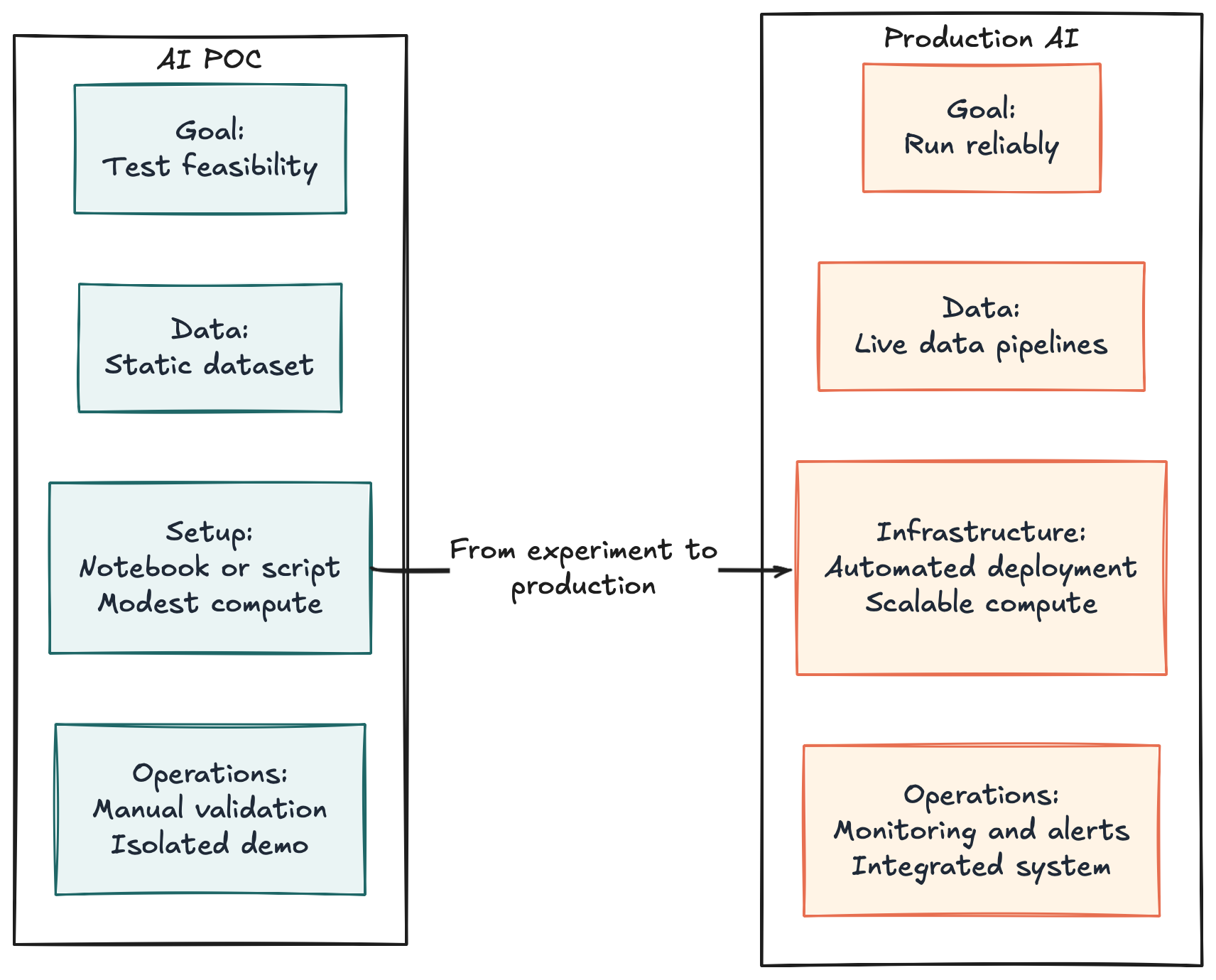
This is why many AI initiatives struggle after the POC stage. The model may work in an experiment, but the organization may not yet have the infrastructure required to make it run continuously, securely, and at scale. In that sense, the challenge is not only to build AI models, but to build the environment in which AI models can become production systems.
Why Cloud Infrastructure Matters for Production AI
Cloud infrastructure matters because production AI is rarely a single application running on a single server. It is usually a chain of services: data ingestion, storage, processing, training, deployment, monitoring, security, and integration. Each part needs to work reliably with the others.
This is difficult to achieve with traditional infrastructure because AI workloads are variable. A team may need modest compute during development, more compute for training, GPU resources for deep learning, and scalable environments when the model is deployed to many users, sites, or business units. Cloud-like infrastructure makes this flexibility easier by providing resources on demand instead of forcing every team to wait for dedicated servers, manual configuration, or one-off environments.
The value of cloud is also in the services around compute. Modern AI teams need a platform layer that connects storage, data processing, model management, deployment, monitoring, and security. These capabilities make it easier to turn an AI experiment into a system that can be deployed, monitored, updated, and maintained over time.
This does not mean that every workload must run on a foreign public cloud. The key requirement is not the location of the servers, but the capabilities of the platform. AI-ready infrastructure can be public cloud, private cloud, local cloud, hybrid cloud, or edge infrastructure. What matters is that it provides elasticity, automation, standardized environments, security, observability, and governance.
Without this foundation, AI teams can still build models, but they remain dependent on manual work and fragmented infrastructure. Cloud-like infrastructure is what allows AI to move from isolated technical work to standardized, scalable, and maintainable production systems.
Morocco’s Current Infrastructure Reality
Morocco’s AI infrastructure challenge should be understood in the context of the country’s broader cloud maturity. The issue is not that companies do not use technology, but that much of the infrastructure remains traditional, internally managed, and not always designed for scalable AI workloads.
The CESE report gives a useful picture of this reality. It shows that Morocco’s cloud adoption remains limited compared with more mature markets, and that many organizations still prefer direct ownership and in-house management of infrastructure and applications. This preference gives organizations more control, but it can also limit the benefits normally associated with cloud infrastructure: scalability, resource sharing, resilience, automation, and faster access to new technologies.
This limited use of cloud, especially foreign public cloud, is understandable in the Moroccan context. For organizations such as banks, insurance companies, telecom operators, public administrations, and strategic infrastructure operators, the decision is not only technical or financial. It is also linked to data security, privacy, sovereignty, regulatory requirements, and trust.
A bank supervised by Bank Al-Maghrib, an insurance company supervised by ACAPS, a telecom operator regulated by ANRT, or a public entity managing sensitive citizen data cannot treat infrastructure location as a secondary detail. These organizations need to know where data is hosted, who controls the infrastructure, which laws apply, and how security and compliance are guaranteed.
At the same time, Morocco’s national and sovereign cloud offer is still limited. CESE notes that local cloud services remain largely focused on basic infrastructure services such as hosting, IaaS, backup, disaster recovery, and security. These services are important, especially for data residency and business continuity, but they do not yet provide the full depth of advanced capabilities needed for AI at scale.
This creates a structural tension for AI readiness. International public cloud providers offer a deeper AI-ready service layer, from elastic compute and GPU infrastructure to managed data and AI platforms. But for sensitive workloads, their use may be limited by security, privacy, sovereignty, or regulatory concerns. National or sovereign cloud can address the control and data-residency side, but it may not yet offer the full AI-ready service layer needed to industrialize AI systems.
This is why Morocco’s cloud maturity is directly linked to its AI readiness. The challenge is not only to create AI teams or launch POCs, but to build an infrastructure foundation that can support production AI while respecting the constraints of security, privacy, and sovereignty.
Data Classification: The Key to a Practical Hybrid Cloud
The previous section shows the dilemma clearly. On one side, foreign public cloud remains difficult to use for some workloads because of security, privacy, sovereignty, and regulatory concerns. On the other side, self-hosted or on-premise infrastructure often does not provide the elasticity, automation, managed platforms, and deployment capabilities required for production AI.
This is why data classification becomes central. Not all data carries the same level of sensitivity. Customer records, financial data, public-sector data, health information, and critical industrial data should not be treated in the same way as anonymized datasets, aggregated operational indicators, synthetic data, or non-sensitive workloads.
Clear classification allows companies to decide what can run where. Sensitive or classified data can remain on on-premise infrastructure, private cloud hosted locally, or sovereign cloud. Less sensitive, anonymized, or aggregated data can be used on mature public cloud platforms when appropriate. This matters for AI because international cloud providers already offer mature AI-ready platforms that can accelerate experimentation and production when data constraints allow it.
CESE also highlights this issue in its 2023 report on cloud computing. The report notes that data classification is necessary to guide the choice between public and private cloud models, but that the classification process remains slow. Without this clarity, organizations may either keep everything internally “just in case,” slowing down AI deployment, or move workloads to cloud without a mature governance framework.
For AI readiness, classification is therefore not only a compliance exercise. It is an infrastructure enabler. It allows companies to use mature cloud services where they can, while keeping sensitive data under the right level of control.
For classified and sensitive data, Morocco will still need a stronger sovereign cloud layer. This is aligned with the direction of Digital Morocco 2030, which points to the development of sovereign cloud for the public sector and organizations of vital importance, alongside public cloud offerings for non-vital use cases. In that model, hybrid cloud becomes practical: mature public cloud can accelerate AI where data constraints allow it, while sovereign cloud can support sensitive workloads as the national offer develops.
The real challenge is to avoid treating all data as if it had the same risk. Without classification, hybrid cloud remains theoretical. With classification, companies can start building AI systems on the right infrastructure: public cloud where possible, sovereign or local infrastructure where necessary.
AI Readiness Is Infrastructure Readiness
Moroccan companies are right to invest in AI teams, data science initiatives, and proof-of-concept projects. These are necessary steps to explore opportunities and identify valuable use cases. But they are only the beginning.
The real challenge starts when companies try to move from a successful demo to a system that runs reliably in production. At that stage, the limiting factor is often no longer the model itself, but the infrastructure around it.
This is why cloud maturity matters for AI readiness. Traditional on-premise or self-hosted infrastructure can provide control, but it often lacks the flexibility and advanced services required for production AI. International public cloud offers mature capabilities, but its use may be limited by privacy, security, sovereignty, and regulatory constraints. National and sovereign cloud can address some of these constraints, but this layer still needs to mature to fully support AI at scale.
For Morocco, the path forward is not to choose blindly between public cloud and local infrastructure. It is to build a practical hybrid model based on clear data classification. Non-sensitive, anonymized, or aggregated workloads should be able to benefit from mature cloud capabilities where appropriate, while sensitive and classified data should be supported by stronger local and sovereign cloud infrastructure.
In the end, AI will not scale through POCs alone. It will scale when companies build the infrastructure foundation that allows models to be deployed, monitored, secured, maintained, and integrated into real operations. Morocco’s AI readiness will depend on this shift: from experimenting with AI to building the platforms that make AI production-ready.